More capacity, new connections and CT metering for commercial, industrial and multi-tenant sites. Maximum demand studies, board works and Energex and Ergon coordination managed end to end.
Initial project reviews returned within one business day.
When you may need it
Most supply upgrade conversations start with a tripping main, a new tenant or an Energex requirement, raised by a facility manager, business owner, builder or electrician.
Direct answer
CT (current transformer) metering measures site consumption through current transformers rather than directly through the meter. Energex and Ergon require CT metering on commercial sites where demand exceeds direct-connect meter capacity, typically above 100A per phase.
A CT metering or supply upgrade can include a maximum demand study, board modifications or a new CT board, a sealed CT chamber, supply authority applications and metering coordination through to energisation.
Commercial Switchboards manages the whole path: measured load data, board works, Energex and Ergon applications and the metering changeover, with the site kept running through the works.
CT metering and supply upgrades are coordinated directly with Energex and metered to AS/NZS 61439, so the connection is compliant, the CT metering is accurate and the changeover is documented end to end.
The real risk
The technical work is rarely the hold-up. Projects stall on undersized applications, missing load data, metering requirements discovered late and slow authority back-and-forth. Months can pass while a tenant waits for power.
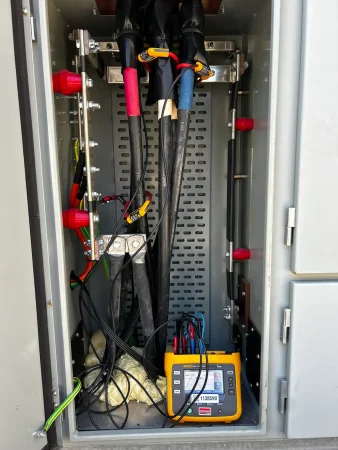
Three-phase load study in progress
Scope
Grouped by stage so asset owners and facility managers can see exactly what we manage. The documentation we hand over keeps the works defensible to the supply authority, insurers and incoming asset managers.
01
Power logging with a Fluke 1738 logger – Measured maximum demand, not bill estimates – Spare capacity and future load allowance – Board condition assessed for CT works
02
Energex and Ergon applications prepared and submitted – Metering and connection requirements confirmed up front – Negotiated supply arrangements where applicable – Application tracking through to approval
03
New CT board build or modification of the existing board – Sealed CT chamber to supply authority requirements – CT ratios and accuracy class matched to the metering – Metering panel and isolation works
04
Meter provider coordination and changeover scheduling – Multi-tenant metering configurations – Sealing and compliance requirements – Tenant notifications where supplies are affected
05
Staged changeover around trading and tenants – Testing and verification before energisation – Certificates and compliance documentation – As-installed records and metering details
Cost factors
Every site is different, so pricing is confirmed after the load data is in. These are the factors that drive cost on supply upgrades and CT metering works.
A modest capacity bump within the existing connection costs far less than a jump that triggers network augmentation by the authority.
A board with space and capacity can take CT works. An end-of-life board may need upgrading before the metering can go in.
A metering change is quick. New connections, negotiated supply or network augmentation add authority fees and lead time.
Modifying a suitable existing board is cheaper than building a new CT board, which is sometimes the only compliant path.
A single CT meter is simpler than multi-tenant metering with individual tenant changeovers.
Live sites needing after-hours changeovers cost more than sites that can take a planned daytime outage.
Our approach
Detailed load studies, engineering reports and negotiated supply applications are scoped separately depending on project requirements.
DELIVERY PROCESS
From load data through applications, board works and changeover, we manage the moving parts so you are not chasing the authority yourself.
DAY 1
WEEKS 1-2
APPROVAL WINDOW
SCHEDULED
Related pages
If the supply upgrade points to a bigger board problem or a specific site type, these pages may help.
Related services
Why us
Most Electrical Contractors
Commercial Switchboards
Backed by 10 years of practical switchboard depth: 6 years building and commissioning LV, MV and HV switchboards on the iPower factory floor, 3 years underground at Lady Loretta running 11kV substations and live HV switching, and end-to-end delivery of a remote open-cut gold mine in central Africa.
A commercial supply upgrade in Brisbane typically costs $20,000 to $80,000 where board works are involved, depending on board condition, metering configuration and authority scope. The CT metering coordination component typically adds $3,000 to $8,000. Simple metering changes on a suitable board sit well below these ranges. Pricing is confirmed after a load study and initial project review.
CT metering is required by Energex and Ergon when site demand exceeds direct-connect meter capacity, typically above 80A per phase. It is standard on commercial supply upgrades, multi-tenant sites and new commercial connections with three-phase loads above that threshold. The CTs sit in a sealed chamber within the switchboard and must match supply authority ratio and accuracy requirements.
A commercial supply upgrade typically takes 6 to 12 weeks end to end, driven mostly by supply authority approval times. Simple metering changes are faster. Board works run in parallel with the approval window so the changeover can happen as soon as the authority signs off. Network augmentation projects run longer.
Yes, and it is the cheapest insurance on the project. A measured maximum demand study with a power logger replaces bill-based guesswork, sizes the application correctly the first time and often shows the existing connection has more headroom than assumed, which can avoid the upgrade entirely.
Yes. Applications, metering requirements, negotiated supply arrangements and the back-and-forth with Energex or Ergon are managed end to end. Applications are submitted with measured load data, which is the single biggest factor in avoiding rejections and resubmissions.
Briefly, and on a schedule you control. Metering changeovers are staged around trading hours and tenants, completed after hours where required, with temporary supply arranged for critical loads. Most changeovers are measured in hours, not days.
Sometimes. The board needs the space, condition and fault rating to take a sealed CT chamber. Where it does not, the metering work is combined with a board upgrade so the site is touched once, not twice. The board assessment happens before the application is lodged, never on changeover day.
Start with the nameplate data of the new equipment and a load study of the existing supply. From there the path is either spare capacity confirmed, a supply upgrade application or, for larger sites, a conversation about HV supply. We confirm the right path within one business day of reviewing the details.
Yes. Multi-tenant metering configurations, individual tenant changeovers and tenant notifications are coordinated as part of the works, with each tenancy kept live through its own scheduled changeover window.
A maximum demand study measures the site’s real peak load over time using a power logger, typically a Fluke 1738. The measured figure replaces estimates in supply authority applications, board sizing and capacity planning. Logging usually runs one to four weeks depending on the site’s operating cycle.
No. Commercial Switchboards delivers commercial and industrial work only. Residential supply upgrades and meter changes belong with a general electrical contractor.
Handover includes certificates, metering details and as-installed records, plus the measured load data for your asset file. Where the works exposed an ageing board or thermal issues, the findings are documented with recommendations so the next project starts informed.
Send through your power bills, what is being added and any Energex or Ergon correspondence. We review the details and confirm the right path within one business day.