
Scheduled inspections, torque-checked connections, thermal baselines and reactive response under one maintenance contract. Boards that get maintained do not make the breakdown list.
Initial project reviews returned within one business day.
When you may need it
Most maintenance conversations start after a scare: a failure, an insurance question or an audit, raised by facility managers, body corporates and asset owners.
Direct answer
Commercial switchboard maintenance is a scheduled program of inspection, testing and preventative work that keeps boards safe, compliant and off the breakdown list. It is the difference between planned attention and emergency response.
A maintenance visit can include visual and thermal inspection, torque checks on connections, switchgear operation checks, earth testing, cleaning and a condition report with photographs for the asset register.
Commercial Switchboards runs maintenance contracts from single boards through to multi-site portfolios, with findings documented and repairs staged before they become failures.
Scheduled switchboard maintenance is carried out to AS/NZS 61439, covering thermal scans, torque checks and protective-device testing. A planned switchboard maintenance program keeps multi-board portfolios compliant and gives asset owners a documented service history.
The real risk
Loose connections heat slowly, then fail instantly, usually under peak load, in trading hours, when the failure costs most. The failed isolator pictured cost a supermarket its trading day. A torque check would have cost minutes.
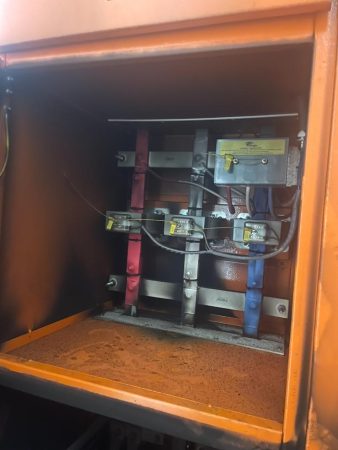
Failed 800A isolator at a trading supermarket. Preventable.
Scope
Grouped by what happens on and after each visit. The documentation is the product: every visit leaves the asset register stronger.
01
Visual condition of switchgear, busbars and enclosures – Switchgear operation checks – Labelling and circuit schedule accuracy – Enclosure sealing and ingress condition
02
Torque checks on connections and terminations – Earth testing with recorded readings – Protection device function checks where applicable – Readings logged visit to visit
03
Thermal imaging scan of each board under load – Baseline comparison against previous visits – Hotspots flagged with severity and priority – Reports formatted for insurers and asset registers
04
Condition report with photographs – Defect list with priorities and recommendations – Asset register updates for every board – Compliance documentation maintained
05
Priority response for contract clients – Repairs staged from maintenance findings – Emergency support when something still fails – Spares recommendations for critical gear
Cost factors
Maintenance is priced per board per visit, confirmed after the baseline visit. These are the factors that move the number.
One board at one site is a service call. Forty boards across six sites is a program with route planning and portfolio reporting.
A small distribution board takes minutes. A multi-section MSB with CT metering takes longer to inspect, test and document properly.
Live-site visual and thermal work is straightforward. Torque checks need isolation windows, which take coordination on trading sites.
Annual suits most commercial boards. Six-monthly suits critical, harsh-environment or insurer-flagged sites.
Well-kept boards baseline quickly. Neglected boards carry catch-up defects that need staging before the program settles.
Basic condition notes cost less than insurer-grade reporting with thermal baselines and asset register integration.
Our approach
Defect rectification identified during maintenance is scoped separately before any work proceeds.
DELIVERY PROCESS
From first contact to a running schedule, the program is built so boards stop being a surprise and start being a line item.
Related pages
If maintenance findings point to repairs, upgrades or a specific site type, these pages may help.
Related services
Why us
Backed by 10 years of practical switchboard depth: 6 years building and commissioning LV, MV and HV switchboards on the iPower factory floor, 3 years underground at Lady Loretta running 11kV substations and live HV switching, and end-to-end delivery of a remote open-cut gold mine in central Africa.
Most commercial boards run $500 to $1,500 per board per year depending on size, access and reporting depth, with multi-board and multi-site programs priced lower per board. The baseline visit sets the number, and pricing is fixed per board per visit from there. Compared with one emergency failure in trading hours, the program usually pays for itself the first time it catches something.
Annually for most commercial boards. Six-monthly for critical sites, harsh environments, heavily loaded boards or where an insurer requires it. The right frequency is set after the baseline visit, board by board, not one-size-fits-all.
A thermal baseline is a reference thermal image of each board under normal load, captured on the first visit and compared on every visit after. Connections fail by heating slowly over months, and the comparison catches the trend before the failure, which is the whole point of the program.
Connections loosen over time through thermal cycling and vibration. A loose connection increases resistance, generates heat and eventually fails, often taking switchgear with it. Torque-checked connections logged visit to visit are the cheapest prevention in the program.
Increasingly, yes in practice. Insurers ask for switchboard condition records after claims and at renewal, auditors ask for them on asset registers, and unmaintained boards are a common exclusion argument. The maintenance reports are written so they can go straight to an insurer, auditor or incoming asset manager.
Most of it. Visual inspection and thermal imaging run live, under normal load, which is exactly when thermal data is most useful. Torque checks need isolation, which is staged board by board around trading hours or scheduled windows.
It goes in the report with a priority, a photo and a recommendation. Urgent hazards are flagged immediately, repair scope is confirmed in writing before any work proceeds, and contract clients get priority scheduling on the rectification.
Yes. Most boards on our programs were installed by someone else. The baseline visit documents what exists, regardless of who built it, and the program runs from there.
Yes. Multi-site portfolios run on one schedule with consistent reporting per board per site, which is exactly what body corporates, facility managers and asset owners need for their registers.
Contract clients get priority response when something fails between visits. Emergency repair works are scoped separately, but the program means failures are rarer, smaller and never a mystery, because the board history already exists.
No. Commercial Switchboards delivers commercial and industrial work only. Residential switchboard maintenance belongs with a general electrical contractor.
Send through your board list, sites and photos if you have them. We confirm the program shape within one business day, run the baseline visit and deliver the first condition report with the maintenance calendar.
Send through your board list, sites and any existing records. We review the details and confirm the program shape within one business day.