
Hotspots and loose connections found before they fail. Thermal scans under real load, with reports built for insurers, asset registers and maintenance planning.
Initial project reviews returned within one business day.
When you may need it
Most thermal imaging requests start with an insurer letter, a warm smell or a board nobody has looked inside for years, raised by facility managers, body corporates and asset owners.
Direct answer
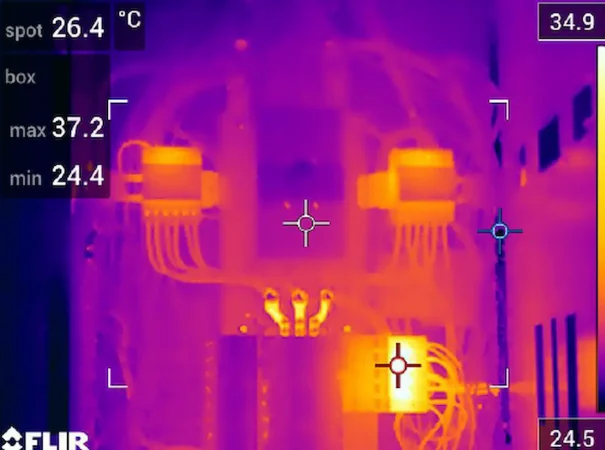
Switchboard thermal imaging uses an infrared camera to find heat where it should not be: loose connections, overloaded circuits and failing switchgear. Faults heat up long before they fail, and the camera sees it months early.
A thermal scan is done live, under normal site load, with no shutdown required. Findings are graded by severity and delivered in a report with thermal and standard photographs of every issue.
Commercial Switchboards delivers one-off scans, pre-purchase inspections and recurring thermal baselines as part of maintenance contracts, with repairs staged before failures happen.
Switchboard thermal imaging is carried out against the inspection principles behind AS/NZS 3000 and AS/NZS 61439, so every switchboard thermal imaging survey gives you a documented baseline and a clear record of any hot joints found.
Routine switchboard thermal imaging is the cheapest insurance a facility manager can buy. A switchboard thermal imaging survey takes hours, not days, and finds the loose terminations and overloaded circuits that start fires, long before they fail.
The real risk
A loose connection can run for months, heating, oxidising and heating further, before it fails in minutes. The thermal camera is the only tool that sees the problem while it is still a ten-minute fix instead of a trading-day outage.
Scope
Grouped by what happens before, during and after the scan. The report is built to be used, not filed.
01
Scan scheduled for normal or peak site load – Access planned with no shutdown required – Board list and schedules confirmed – Safety and access controls in place
02
Every accessible board scanned under load – Connections, switchgear and busbar zones covered – Paired thermal and visual photographs – Live readings recorded per board
03
Findings graded by severity – Temperature rise assessed against load conditions – Repeat-offender components flagged – Comparison against previous baselines where they exist
04
Insurer and auditor-ready report – Prioritised defect list with recommendations – Repair scopes for every actionable finding – Asset register documentation
05
Repairs staged by priority – Re-scan after rectification to confirm the fix – Baseline saved for the next scan – Maintenance program option from the findings
Cost factors
Thermal imaging is priced per board, confirmed before the visit. These are the factors that move the number.
One board is a visit. A portfolio across multiple sites is a program with route planning and per-site reporting.
A small distribution board scans in minutes. A multi-section MSB with covers to remove takes longer to do properly.
Scans need genuine load to mean anything, so timing around site operations matters more than the camera.
A basic findings summary costs less than insurer-grade reporting with baselines and asset register integration.
Confirming repairs with a follow-up scan adds a visit but closes the loop the insurer wants to see closed.
One-off scans carry full visit costs. Scans inside a maintenance contract share the visit and cost less per board.
Our approach
Defect rectification identified during scanning is scoped separately before any work proceeds.
DELIVERY PROCESS
From board list to graded report, the process is built to interrupt nothing and document everything.
Related pages
If the scan findings point to repairs, maintenance or a specific site type, these pages may help.
Related services
Why us
Backed by 10 years of practical switchboard depth: 6 years building and commissioning LV, MV and HV switchboards on the iPower factory floor, 3 years underground at Lady Loretta running 11kV substations and live HV switching, and end-to-end delivery of a remote open-cut gold mine in central Africa.
Standalone thermal imaging typically runs $150 to $400 per board depending on board size, access and reporting depth, with portfolio and multi-site pricing lower per board. Scans inside a maintenance contract cost less again because the visit is shared. Pricing is confirmed before the visit, per board, with no surprises.
No, and it must not. Thermal imaging only works under load, so the scan runs live during normal operations. No outage, no tenant disruption, no production interruption. That is the whole appeal of thermal imaging as a condition tool.
Annually for most commercial boards, six-monthly for critical or heavily loaded sites, and after any major load change or switchboard works. Insurers increasingly expect an annual cycle on commercial sites.
Every finding gets a paired thermal and visual photograph, a severity grade, the measured temperature rise and a recommendation with repair scope. The report is formatted for insurers, auditors and asset registers, and the prioritised defect list makes the next step obvious.
Heat is the symptom, and heat only shows under current. A board scanned at low load can hide a connection that glows at peak. Scans are timed for genuine operating load, ideally peak, so the data means something.
That is one of the most common reasons we are engaged. The report is written to answer insurer requirements directly: condition evidence, graded findings, rectification records and a dated baseline. Where the insurer has a specific format or requirement, the report is matched to it.
It is graded on the spot. Urgent findings are flagged the same day with a make-safe recommendation, and everything else lands in the prioritised defect list with a repair scope. Repairs are agreed in writing before any work proceeds, and a re-scan confirms the fix.
A thermal baseline is the reference scan of each board under normal load, kept and compared on every future scan. Connections fail by trending hotter over months, and the comparison catches the trend long before the failure.
Yes. Most boards we scan were installed by someone else. The scan documents what exists, whoever built it.
Yes. Every maintenance visit includes a thermal scan against the board’s baseline. Standalone scans are also available for sites that are not on a program yet, and most programs start exactly that way.
No. Commercial Switchboards delivers commercial and industrial work only. Residential thermal imaging belongs with a general electrical contractor.
Send through your board list, sites and photos if you have them. We confirm per-board pricing and the scan schedule within one business day, timed around your site’s load and operations.
Send through your board list, sites and any insurer requirements. We confirm pricing and a scan schedule within one business day.