When a main switchboard fails, an entire commercial site can go dark in seconds. Tills stop, tenants start calling, refrigeration warms up and production lines fall silent. For a facility or property manager the clock starts straight away, and the worst decisions get made in a panic.
This is the calm version. Below is what a main switchboard failure looks like, why it happens, the exact steps to take in the moment, and how a proper commercial switchboard repair gets you trading again without cutting corners on compliance.
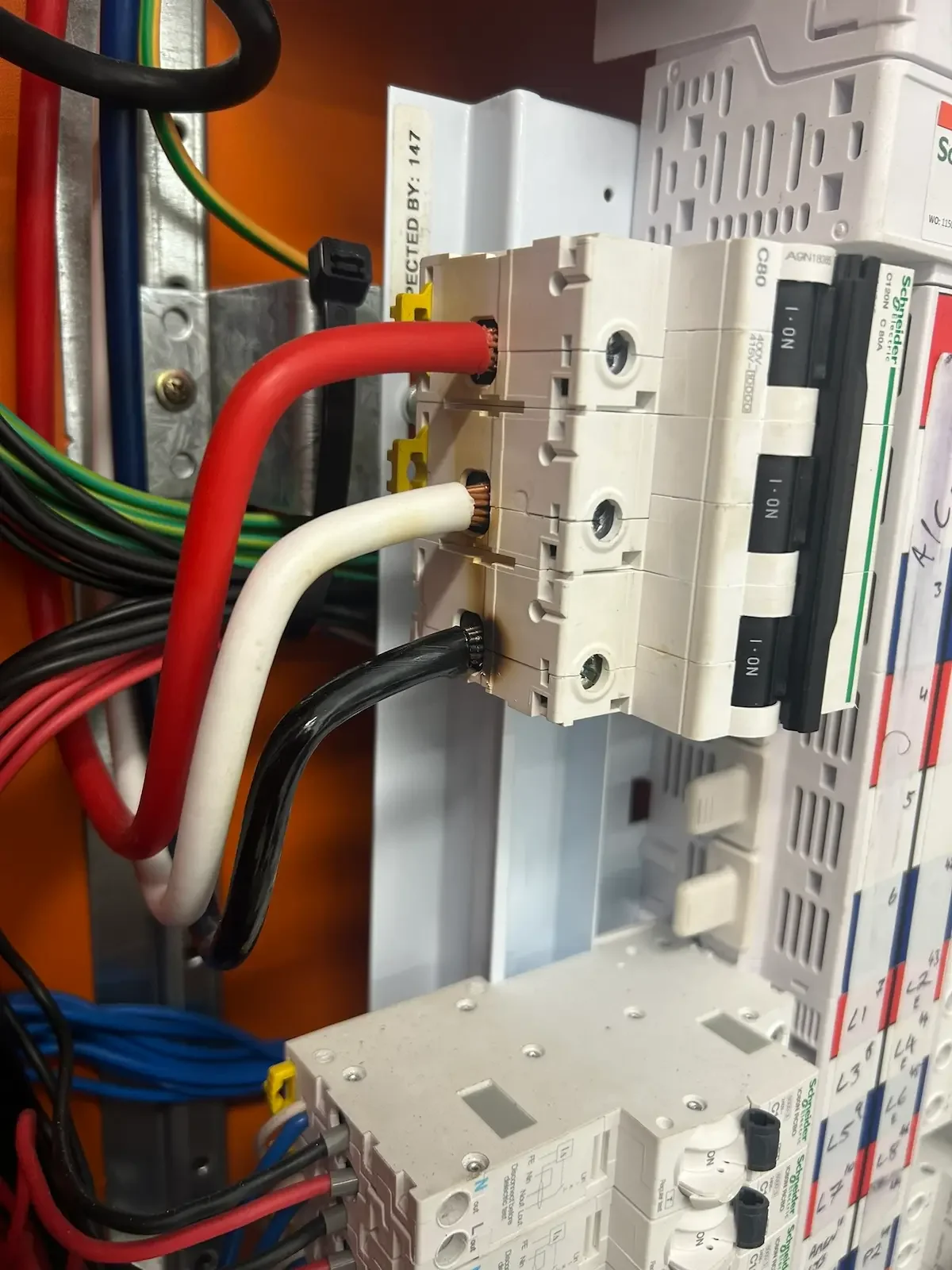
What a main switchboard failure actually looks like
A main switchboard failure is rarely subtle. It usually shows up as one or more of these:
- A total loss of power across the building or a large section of it
- A burning smell coming from the main switch room
- Visible smoke, scorching or discolouration on the board
- A loud bang, buzzing or arcing sound
- Main breakers that trip again the moment they are reset
- Heat radiating from the enclosure or warm cover panels
Any of these means the board should be treated as unsafe until a licensed specialist has inspected it. A main switchboard carries the entire incoming supply for the site, so a fault here is in a different league to a tripped circuit on a distribution board.
What causes a main switchboard to fail?
Most commercial main switchboard failures come down to three things working against each other over time: age, load and heat.
Overloading. Buildings change. Over a decade a site adds air conditioning, EV chargers, extra tenancies and new equipment, and the original board was never sized for any of it. Running constantly near or over capacity slowly cooks components.
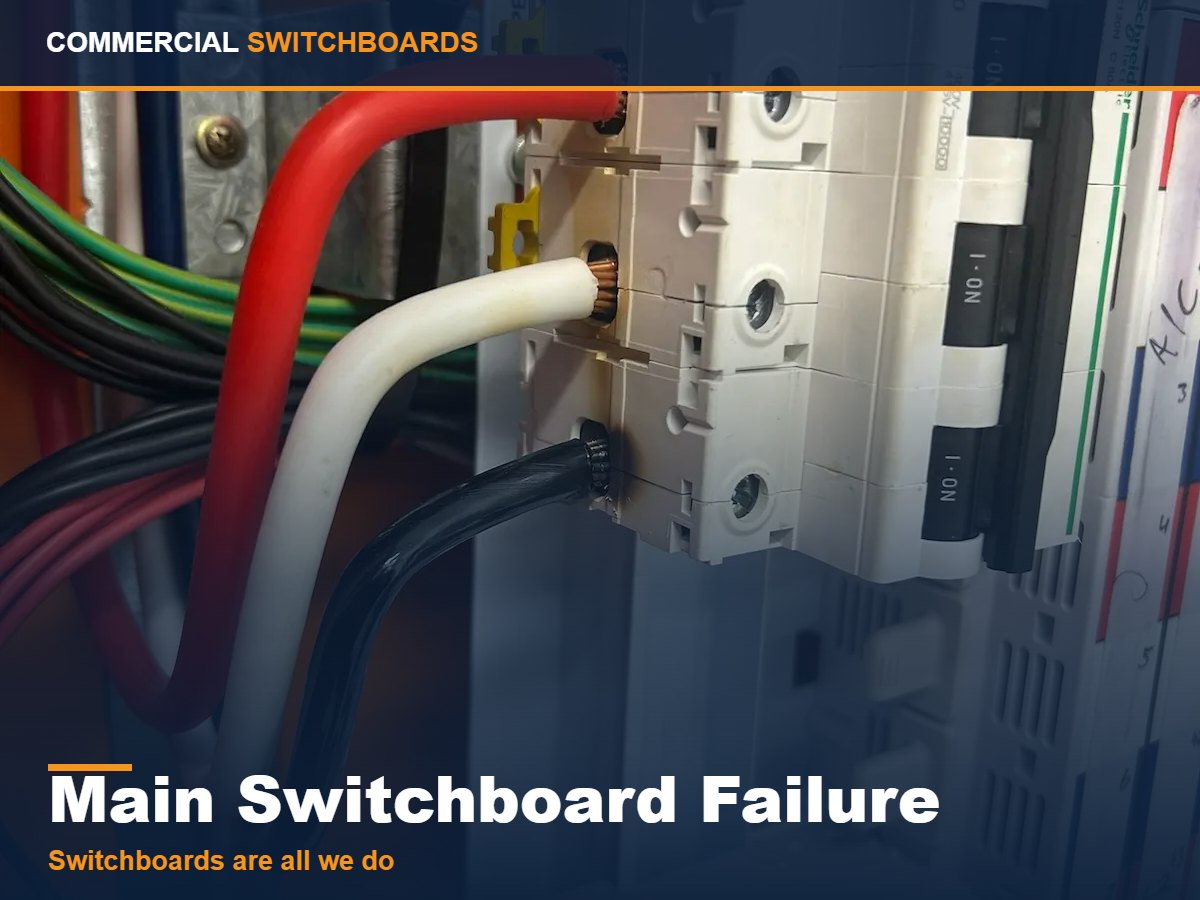
Loose and corroded connections. Every termination is a potential hot spot. As connections loosen through thermal cycling or corrode in humid and coastal air, resistance rises, heat builds and something eventually burns out. This is the single most common failure point on commercial boards.
End-of-life switchgear. Main switches, breakers and fuses have a service life. Obsolete gear, unavailable spare parts and brittle insulation all push up the risk of a sudden failure.
Environment. Water ingress, dust, vermin and insects inside an older enclosure cause tracking and short circuits.
Non-compliance. Boards that no longer meet AS/NZS 61439 have often been modified over the years without verification, which leaves them unpredictable under fault conditions.
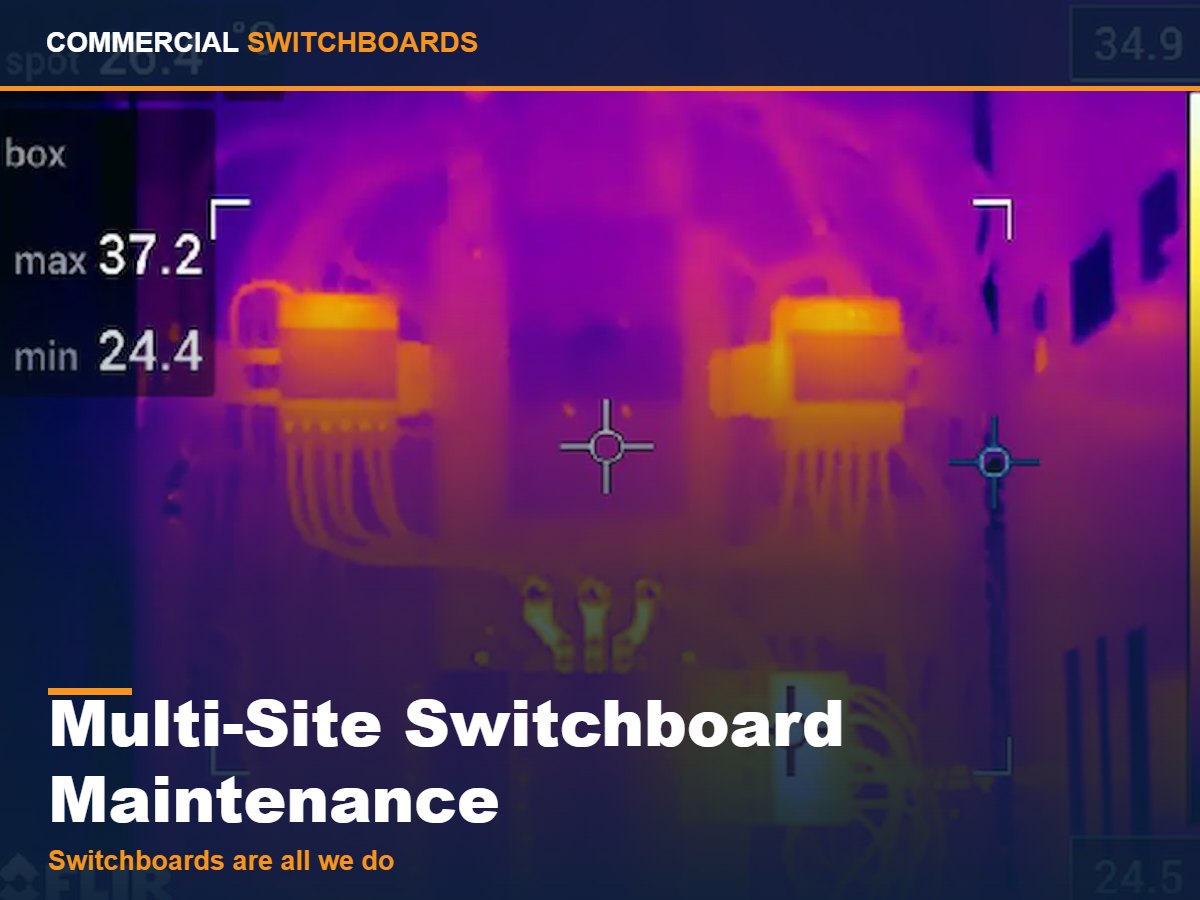
Almost all of these give warning signs first, which is exactly what switchboard thermal imaging is built to catch before the board goes down.
7 proven steps to take when your main switchboard fails
- Keep people clear. Treat any burning smell, smoke or arcing as dangerous and move people well away from the board and the switch room.
- Do not touch the board. Never open, poke or hose a failed main switchboard. Live commercial boards carry lethal voltages and a fault can arc.
- Isolate only if it is safe. If there is a clearly labelled, accessible main isolator and you can reach it without risk, switching off can limit further damage. If there is any doubt, leave it.
- Call a licensed commercial electrician. A main switchboard is not a job for a handyman or a general electrician. You need a contractor who specialises in switchboards and works to AS/NZS 61439.
- Record what happened. Note what was running, any noises, smells or trips, and the time it happened. It speeds up fault finding and can save an hour on site.
- Protect sensitive equipment. Where it is safe to do so, switch off sensitive loads so they are not damaged by a surge when power is restored.
- Plan for repair or replacement. Once the site is safe, have a specialist assess whether a repair or an upgrade is the right call, rather than rushing a patch that fails again next week.
Repair or replace? How to decide
Not every failure means a full replacement, and not every board is worth saving. Patching a board that is past its life is false economy, but replacing one that only has a localised fault is money wasted. A specialist weighs four things: the board’s age, its remaining spare capacity, whether replacement parts are still available, and whether it currently meets AS/NZS 61439. As a rough guide:
| A repair usually makes sense when | An upgrade usually makes sense when |
|---|---|
| The fault is localised to one component or connection | The board is overloaded or out of spare capacity |
| The board is otherwise sound and not too old | It fails or trips repeatedly |
| Replacement parts are still available | Parts are obsolete or no longer made |
| The board still meets current standards | It no longer meets AS/NZS 61439 |
If two or more points fall on the right-hand side, a main switchboard upgrade is usually the better long-term call. If it is a clean, one-off fault, a switchboard repair will get you trading again quickly.
What a commercial switchboard repair actually involves
Specialist commercial switchboard repairs follow a disciplined process rather than a quick patch:
- Isolate and make safe so the site and the technician are protected.
- Find the root cause, not just the symptom, so the same fault does not return.
- Repair to AS/NZS 61439 using correctly rated components.
- Test the repair before re-energising.
- Document what was done so the board is left compliant and on record.
On trading sites the work is sequenced around your hours so the building gets back to operation with minimal disruption. Where the incoming supply itself is involved, the contractor coordinates the connection directly with Energex so you are not left chasing the supply authority yourself.
What drives the cost of a switchboard repair
Every board is different, but a few factors move the figure more than anything else:
- Extent of the damage. A single failed breaker is a very different job to a burnt-out main section.
- Parts availability. Current gear is quick to source; obsolete components take longer and cost more.
- Access and shutdown windows. After-hours or staged shutdowns on a live site add time.
- Compliance. If the repair uncovers non-compliant work, bringing that section up to standard adds scope.
It is worth weighing any of this against the real cost of the board being down: lost trade, spoiled stock, idle staff and unhappy tenants. On most commercial sites a few hours of downtime costs far more than the repair.
How to prevent a main switchboard failure
Most main switchboard failures are preventable. A planned switchboard maintenance program with periodic thermal imaging, torque checks and testing catches the loose connections and hot joints that cause burnouts long before they take the site down. For owners and facility managers running multi-board portfolios, scheduled maintenance is far cheaper, and far more predictable, than an unplanned outage at the worst possible time.
Why use a switchboard specialist, not a general electrician
A main switchboard failure is not the place to save money on a cheaper trade. A general electrician can change a power point. A main switchboard is a different discipline. A specialist contractor does switchboards every day, builds and repairs to AS/NZS 61439 as standard, carries the right test equipment, and hands back full documentation and a single point of accountability from the first inspection through to energisation. On a commercial site, that depth is the difference between a board that is genuinely fixed and one that is simply patched.
Main switchboard failure: frequently asked questions
Is a main switchboard failure an emergency?
Yes. A failed or burning main switchboard is a safety risk and usually takes the site offline, so it should be treated as urgent and assessed by a licensed specialist straight away.
Can a main switchboard be repaired, or does it need replacing?
It depends on the board’s age, spare capacity and compliance. A localised fault on a sound board can be repaired, while an overloaded or non-compliant board is usually better upgraded.
How long does a switchboard repair take?
A straightforward fault on a board with available parts can often be made safe and repaired quickly, while major damage or obsolete components take longer. A specialist can give you a realistic timeframe once the board has been inspected.
Who should repair a commercial main switchboard?
A licensed electrical contractor who specialises in commercial and industrial switchboards, not a general electrician, because the work must meet AS/NZS 61439.
What does it cost to repair a main switchboard?
It depends on the extent of the damage, parts availability and access. The bigger number to keep in mind is usually the cost of the site being down, which a fast, compliant repair is designed to limit.
How do you avoid a main switchboard failure?
Regular switchboard maintenance and thermal imaging detect overheating connections and ageing components before they fail, so small issues get fixed on a planned visit instead of becoming an outage.
If your commercial main switchboard has failed or is showing the warning signs above, request an initial project review and we will advise the next practical step, fast.