QUICK ANSWER
Many switchboards installed before the early 1990s use asbestos backing panels. An asbestos switchboard is generally safe while undisturbed, but becomes a health risk the moment it is drilled, cut or worked on, releasing fibres. If you have an old board with asbestos backing, it should be identified, handled by licensed people, and usually replaced as part of a switchboard upgrade rather than repaired in place.
If your building was wired before the early 1990s, there is a real chance you have an asbestos switchboard, mounted on an asbestos backing panel. It is one of the most common hidden hazards in older commercial and strata buildings, and it turns a routine switchboard job into one that has to be handled carefully. This guide explains why asbestos is in old switchboards, the risks, how to identify it, and what to do about an asbestos switchboard safely.
Why does an old asbestos switchboard exist?
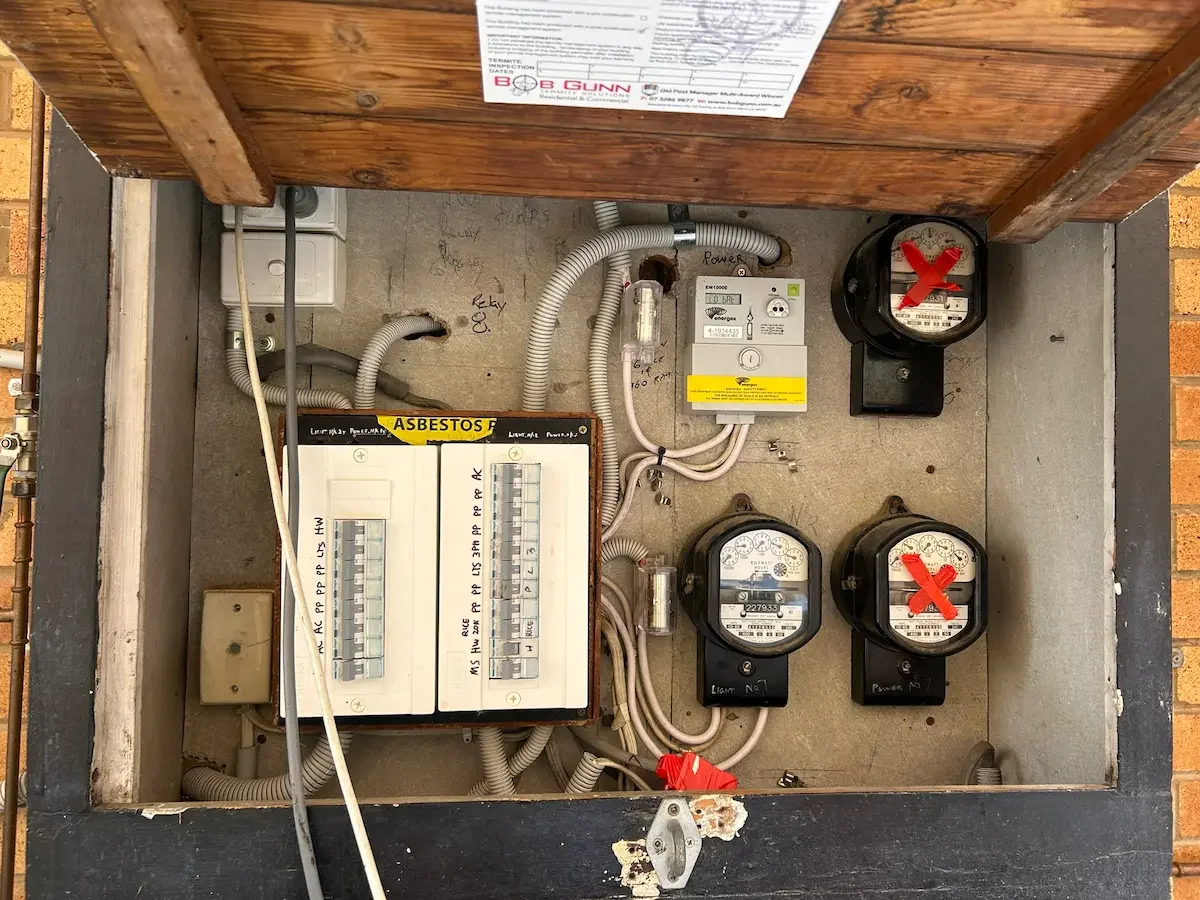
Asbestos was widely used as an electrical backing board because it is fire-resistant and a good insulator, exactly what you want behind a switchboard. From the mid-twentieth century until it was phased out around the late 1980s, asbestos cement sheet was a standard mounting panel for meter boards and switchboards. That means a huge number of pre-1990 commercial, strata and industrial buildings still have an asbestos switchboard in service today.
Key point: an undisturbed asbestos switchboard is generally not a danger. The risk comes from disturbing it, drilling, cutting or removing the panel, which can release fibres. That is why any work on an old board must consider asbestos first.
The risks of an asbestos switchboard on site
- Drilling or cutting the backing releases harmful fibres
- Adding circuits or upgrading the board disturbs the panel
- Deteriorating, damaged or wet panels can shed fibres
- Unlicensed handling exposes workers and occupants
- It complicates and delays any switchboard work if not planned for
How to identify an asbestos switchboard
An asbestos switchboard backing is usually a grey, fibrous cement sheet behind the switchgear. Age is the biggest clue: boards from before the early 1990s are suspect. You cannot confirm asbestos by sight alone, so it must be assessed by a competent person and, where needed, sampled and tested. The safe assumption for any pre-1990 board is to treat the backing as asbestos until proven otherwise.
What to do about an asbestos switchboard
In almost every case, the right answer with an asbestos switchboard is to replace the board rather than keep working around asbestos. A planned switchboard upgrade removes the old asbestos-backed board, with the asbestos handled and disposed of by licensed removalists, and installs a new compliant board built to AS/NZS 61439. This removes the hazard permanently and brings the installation up to current standards in one job.
When an upgrade is the safer choice
If an old board needs new circuits, is overloaded, or has failed, trying to repair an asbestos switchboard around the panel is rarely worth it. The board is usually outdated anyway. Replacing it removes the asbestos risk and the compliance risk together. For body corporate and commercial owners, this is also a clear duty-of-care improvement.
Why use a switchboard specialist
An asbestos switchboard upgrade has to coordinate licensed asbestos removal with the electrical work, safely and with minimal disruption. Because switchboards are all we do, we plan the removal, the new compliant board and the changeover as one project, with full documentation. Ongoing maintenance then keeps the new board in good order.
Asbestos switchboard: frequently asked questions
Do old switchboards contain asbestos?
Many switchboards installed before the early 1990s use asbestos cement backing panels, because asbestos was fire-resistant and a good insulator.
Is an asbestos switchboard dangerous?
An undisturbed asbestos switchboard is generally low risk. The danger comes from drilling, cutting or removing the panel, which can release fibres, so it must be handled by licensed people.
How do I know if my switchboard has asbestos?
Age is the main clue: pre-1990 boards are suspect. You cannot confirm it by sight, so it should be assessed by a competent person and tested where needed.
Can an asbestos switchboard be repaired?
It is usually better to replace it. Working around asbestos is regulated and the board is often outdated, so a planned upgrade removes the hazard and brings it up to standard.
Who removes asbestos from a switchboard?
Licensed asbestos removalists, coordinated with the electrical contractor as part of the switchboard upgrade.
Should I disturb an asbestos switchboard myself?
No. Never drill, cut or remove asbestos backing yourself. It is a serious health hazard and regulated work.
Related guides
- Main switchboard failure: warning signs and fixes
- What a commercial switchboard upgrade costs
- Body corporate switchboard responsibilities
Standards and references
About the author
Anthony Nuich is the owner of Commercial Switchboards, the specialist switchboard division of SEQ Sparky Pty Ltd, holding QLD Electrical Contractor licence #90899. With 10+ years upgrading and replacing ageing commercial, strata and industrial switchboards across Brisbane and Queensland, Anthony reviews every project personally.
If you have an old or asbestos switchboard that needs assessing or replacing, request an initial project review and we will advise the safe next step.